Let’ Em Eat Cake
(1933)
Book by George S. Kaufman ad Morrie Ryskind
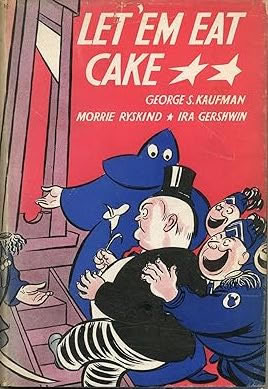
Music by George Gershwin
Lyrics by Ira Gershwin
Cast size: 13 men, 7 women, plus a large singing and dancing ensemble; many locations
Let’ Em Eat Cake opened on October 21, 1933 at the Imperial and ran 90 performances. It had not been revived until the Brooklyn Academy of Music presented a concert version in 1986, in conjunction with Of Thee I Sing.
For performance rights: Concord Theatricals
Table of Contents
The Plot
 In this story, the musical sequel to Of Thee I Sing, President Wintergreen is voted out of office by another ineffectual candidate named Tweedledee. Lacking legal recourse to their woes, the Wintergreens and Alexander Throttlebottom move to New York City and clothe themselves in the blue shirts sewn by Mary. It seems that having a plethora of blue shirts is just the thing to start a revolution, so the Wintergreens and their former Cabinet Officers march on Washington, overthrow the government, and depose Tweedledee.
Wintergreen becomes a dictator and, worse, seems to like it enormously. However, complete control comes at a price and when the League of Nations descends on The Blue House (as it is now known), complications, as they say, ensue—and Wintergreen is rescued only in the nick of time from execution by a military tribunal.
About the play
 The Gershwins seized upon this complex scenario and wrote some of their most exciting work. George’s opening, with its contrapuntal musical duel of campaign songs is one of the most interesting pieces he ever wrote. He continued his notion of placing two melodies against each other with the love song “Mine,” the only song of the show to gain popularity. But, perhaps, not surprisingly, the show that contained these kernels of satirical wisdom was not embraced by audiences when it opened. Violent labor strikes were breaking out all over the country, and it’s unlikely that New York audiences wanted to be reminded of Hitler (brown shirts) and Mussolini (black shirts) as an antidote to chaos. In the end, however, Let ‘Em Eat Cake with its ambitious score and biting satire remains a succes d’estime, which Kaufman defined as:
“a success that runs out of steam.”
Stage history
Let’ Em Eat Cake opened on October 21, 1933 at the Imperial and ran 90 performances.
It had not been revived until the Brooklyn Academy of Music presented a concert version in 1986, in conjunction with Of Thee I Sing. It has been presented in several concert version since then, but no major stage revival has yet been produced.

Other Plays in the Catalogue
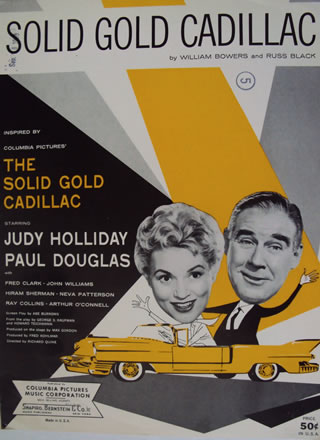
The Solid Gold Cadillac opened at the Belasco Theatre on November 5, 1953, eventually moving to the Music Box Theatre where it closed on Feb 12, 1955, after 526 performances. The narrator was the recorded voice of radio comedian Fred Allen.
Be Yourself (1924). Book by George S. Kaufman and Marc Connelly. Music by Lewis E. Gensler and Milton Schwarzwald. Lyrics by George S. Kaufman and Marc Connelly
A dramatic epic story of assimilation, patriotism and prejudice in America. Kaufman and Hart’s most serious play, The American Way galvanized audiences at the large Century Theater in Rockefeller Center in the last days of the 1930s; it starred Frederic March as the leading character.
Table of Contents
Contact Us Today
Interested in bringing George S. Kaufman’s timeless plays to your stage?
Please refer to the contact information for each specific play on the various collection pages for direct amateur and professional licensing information.
Plays are represented by Concord Theatricals and Music Theatre International respectively.
If you are interested in first-class performance or film/television rights:
In the US, George S. Kaufman’s plays are represented by:
CPK Artists, LLC
In the UK, George S. Kaufman’s plays are represented by:
Alan Brodie Representation
For more information about George S. Kaufman or this website, contact:
Laurence Maslon
Literary Trustee, George S. Kaufman Estate