The Cocoanuts
(1925)
Book by George S. Kaufman
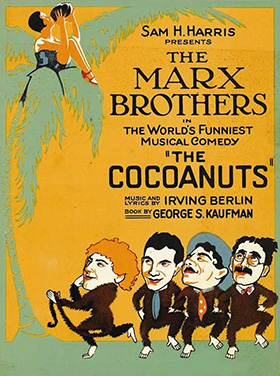
Music and Lyrics by Irving Berlinb
Cast size: 7 men (including the Marx Brothers), 3 women, plus singing and dancing ensemble
The first great Marx Brothers classic is available for a full and fun-filled stage production with an Irving Berlin score. The “plot” is really more of a series of opportunities for the Marx Brothers to let loose their particular brand of insanity. In 2014, Mark Bedard’s adaptation of The Cocoanuts premiered at the Oregon Shakespeare Festival, featuring just 12 actors playing all the roles.
For performance rights (1925 version), contact: Concord Theatricals
For performance rights to reduced version (Mark Bedard), contact: Concord Theatricals – Reduced Version
Table of Contents
The Plot
The “plot” is really more of a series of opportunities for the Marx Brothers to let loose their particular brand of insanity. But, for the record: in the midst of the Florida land boom, Mr. Schlemmer (Groucho) is trying desperately to run Cococanut Manor (“This is Cocoanut manor, no snow, no ice. Well, get some onions, that’ll make your ice water.”) and put the moves on the wealthy The Cocoanuts (“Your eyes—they shine like the pants of a blue serge suit.”).
When Mrs. Potter’s necklace disappears, the suspects are drawn from Silent Sam (Harpo) and Willie (Chico), two vagabonds intent on the stealing the hotel’s silverware, and a hotel clerk in love with Mrs. Potter’s daughter, Polly. It turns out the clerk had been framed by a rival to Polly’s hand, and the whole event ends with pointed hilarity at Spanish costume party. More to the point, the show includes the classic “Why a Duck?” routine, and the classic auction scene.
About the Play
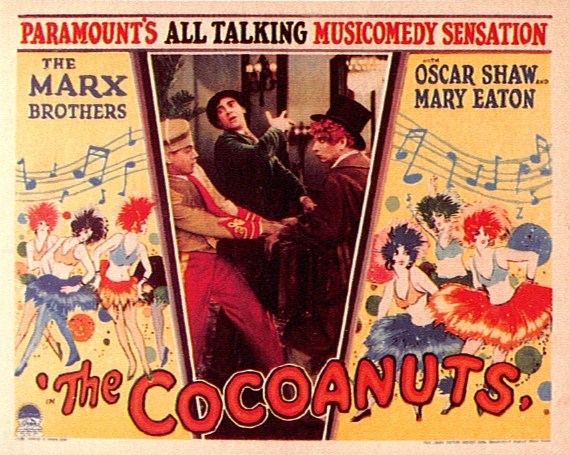 After the Marx Brothers made their first Broadway triumph in a hasty revue called I’ll Say She Is, the boys were flooded with offers by Broadway producers, including Ziegfeld, who would have made their fortune by putting them in his Follies. Chico held out again, this time for a first-class musical written expressly for the act by real Broadway hands, not the hacks who threw together I’ll Say She Is.
Upping the ante won the Marx Brothers the hugest pot imaginable: producer Sam H. Harris hired Kaufman and Irving Berlin, the most acclaimed songwriter of the time, to write their next venture. The Cocoanuts ran for over a year on Broadway and longer on the road. Originally, Berlin had written “Always” for the show, but Kaufman convinced him to cut the song in Atlantic City.
“I don’t know, Irving,” he said, “‘Always’ is a long time—shouldn’t it be I’ll be loving you Thursdays?”
The show also began a deep association between the Marxes and Kaufman, who was constantly exasperated by the boys’ lack of respect for the written word. Once, while standing in the lobby during a performance of the show, Kaufman broke away from a companion with whom he was having a conversation.
“I’m sorry,” said Kaufman when he returned, “I just thought I heard one of my original lines.” It was made into the first musical talking film in 1928.
Stage history
The Cocoanuts opened at the Lyric Theatre on December 8, 1925, where it ran 218 performances. Despite the success of the film version, it had never been professionally revived until a reconstructed text was staged at Washington DC’s Arena Stage in 1986. Subsequently, it was performed at the American Place Theater in NYC in 1996, where “Always” was restored to the score.

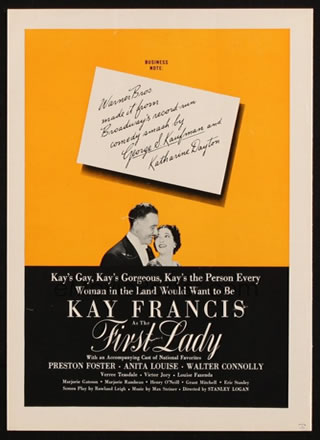
Other Plays in the Catalogue
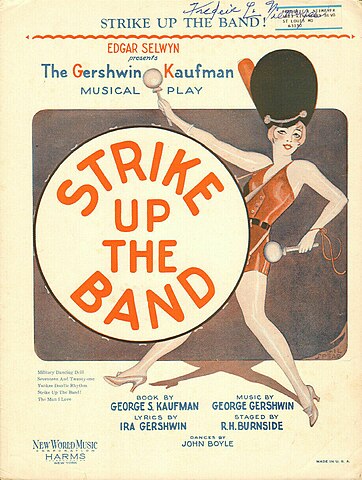
Strike Up the Band opened on January 14, 1930 at the Times Square Theater and ran 191 performances. In 1990, the 1927 book was restored, in collaboration with a Nonesuch/Roxbury recording of all the variants of both versions. The 1927 version was staged by ENCORES! at City Center in 2000 and that version is available for performance.
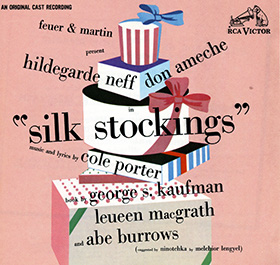
Silk Stockings' producers, Cy Feuer and Ernest Martin, had a success with Guys and Dolls in 1950. Attempting to work again with Kaufman, who directed that production, they ultimately balked at the romantic aspect of Kaufman's adaptation of the film, which he wrote with his second wife, Leueen MacGrath.
Minick is a three-act Broadway play written by Edna Ferber and George S. Kaufman, based on Ferber's 1922 short story "Old Man Minick", that opened on September 24, 1924.
Table of Contents
Contact Us Today
Interested in bringing George S. Kaufman’s timeless plays to your stage?
Please refer to the contact information for each specific play on the various collection pages for direct amateur and professional licensing information.
Plays are represented by Concord Theatricals and Music Theatre International respectively.
If you are interested in first-class performance or film/television rights:
In the US, George S. Kaufman’s plays are represented by:
CPK Artists, LLC
In the UK, George S. Kaufman’s plays are represented by:
Alan Brodie Representation
For more information about George S. Kaufman or this website, contact:
Laurence Maslon
Literary Trustee, George S. Kaufman Estate