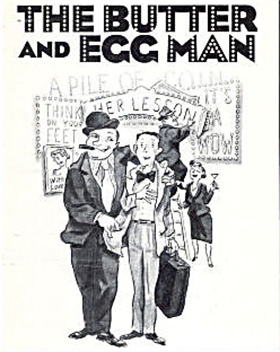
The Butter and Egg Man
(1925)
By George S. Kaufman
Cast size: 7 men, 5 women. Two interiors.
Kaufman had used the considerable knowledge of Broadway production methods he gained working at the New York Times to construct a witty backstage morality play. His only major solo effort among all of his creations, The Butter and Egg Man gives a time-capsule portrait of theater in the 1920s.
For a script, contact: Concord Theatricals
Table of Contents
The Plot
 A “butter-and-egg-man” refers to big roller who comes to the big city with big plans to spend his money on wine, women, and song. Peter Jones, a hotel clerk from Chillicothe , Ohio who comes to New York with $20,000 only wants to produce a Broadway play, in the hopes of using the (enormous) profits to open up a hotel in his hometown. He invests in Her Lesson, an unlikely hit with an aging, overweight ingénue, produced by the slightly shady team of Joe Lehman and Jack McClure. When the play bombs out of town in Syracuse, Jones offers to take the flop off of his producers’ hands—and they gratefully accept. However, Jones is able to make the flop into a hit, and soon he has all of Broadway—including Lehman and McClure—eating out of his hands.
About the Play
Kaufman had used the considerable knowledge of Broadway production methods he gained working at the New York Times to construct a witty backstage morality play. His only major solo effort among all of his creations, The Butter and Egg Man gives a time-capsule portrait of theater in the 1920s. It also seems to be a precursor to Mel Brooks’ The Producers, where two dishonest producers stage a flop that turns overnight into a hit. Still, The Butter and Egg Man is an excellent example of the Kaufman “technique” and a welcome opportunity for smaller theater groups who want to stage a more compact version of a play in the farcical manner of Kaufman’s larger work.
Stage history
The Butter and Egg Man opened on September 23, 1925 at the Longacre Theatre. It ran for 243 performances. There have been several film versions and revivals at regional theaters. It was revived in 2000 at the Atlantic Theatre Company, directed by David Pittu and featuring Michael McGrath and John Ellison Conlee.

Other Plays in the Catalogue
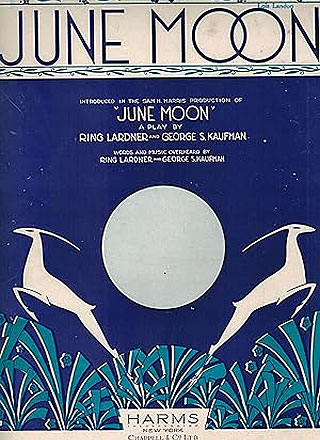
By Ring Lardner and George S. Kaufman. Cast size: 7 men, 5 women (One man can be cut); 3 sets. June Moon was the last major comedy to open on Broadway before the Stock Market Crash. It had its premiere on October 9, 1929 at the Broadhurst and ran 249 performances.
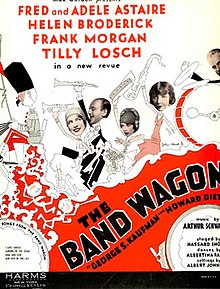
Throughout his career, Kaufman made a fine art out of the revue sketch, the most popular theatrical form on Broadway in the 1920s and early 1930s. Several of his sketches are absolute classics and they can be singly or as part of a larger evening.
Kaufman's first hit comedy was also his initial collaboration with Marc Connelly. Based on a well-known comic heroine made popular in Frank Pierce Adams' column, Dulcy is an engaging comedy about an incipient business deal among suburban neighbors that nearly falls apart.
Table of Contents
Contact Us Today
Interested in bringing George S. Kaufman’s timeless plays to your stage?
Please refer to the contact information for each specific play on the various collection pages for direct amateur and professional licensing information.
Plays are represented by Concord Theatricals and Music Theatre International respectively.
If you are interested in first-class performance or film/television rights:
In the US, George S. Kaufman’s plays are represented by:
CPK Artists, LLC
In the UK, George S. Kaufman’s plays are represented by:
Alan Brodie Representation
For more information about George S. Kaufman or this website, contact:
Laurence Maslon
Literary Trustee, George S. Kaufman Estate